

Fried Chicken | Weak Tea
A reflection about compassion two years after the execution of Phillip Dean Hancock

Kentucky Fried Chicken’s dark meat—original recipe—has this imaginary deliciousness when it’s fresh out of the deep fryer. Crispy—tender with that secret blend of eleven herbs and spices, though really it’s the salt and pepper that hits your palate first. Once the king and queen of spice do their thing, that parade of ingredients reveals itself in waves—paprika’s warmth, garlic’s bite, something almost sweet dancing underneath—until your teeth break through the crackling crust into the dark meat itself, fatty and tender and juicy enough to nearly make you forget it’ll be your last meal.
Fried chicken was pretty much all Phil talked about on our final visit. He’d even “joked” that he wished Governor Stitt would wait to grant him a full pardon until after he ate the bucket of chicken. A free man with a belly full of KFC paid for by the state of Oklahoma, a gallows dream masquerading as hope in his waning hours.
It wasn’t until the next morning that I learned Phil didn’t get the large bucket of KFC dark meat original recipe he’d requested for his last meal. Instead, they gave him a ten-piece chicken tender—soggy on the outside, dry white meat on the inside, served with two sides of indifference and neglect.
I know all of this because I was Phillip Dean Hancock’s chaplain—his spiritual care advisor who stood at his side in the execution chamber on November 30th, 2023. At 11:29 a.m. Phil was pronounced dead by means of lethal injection as ordered by the state of Oklahoma.
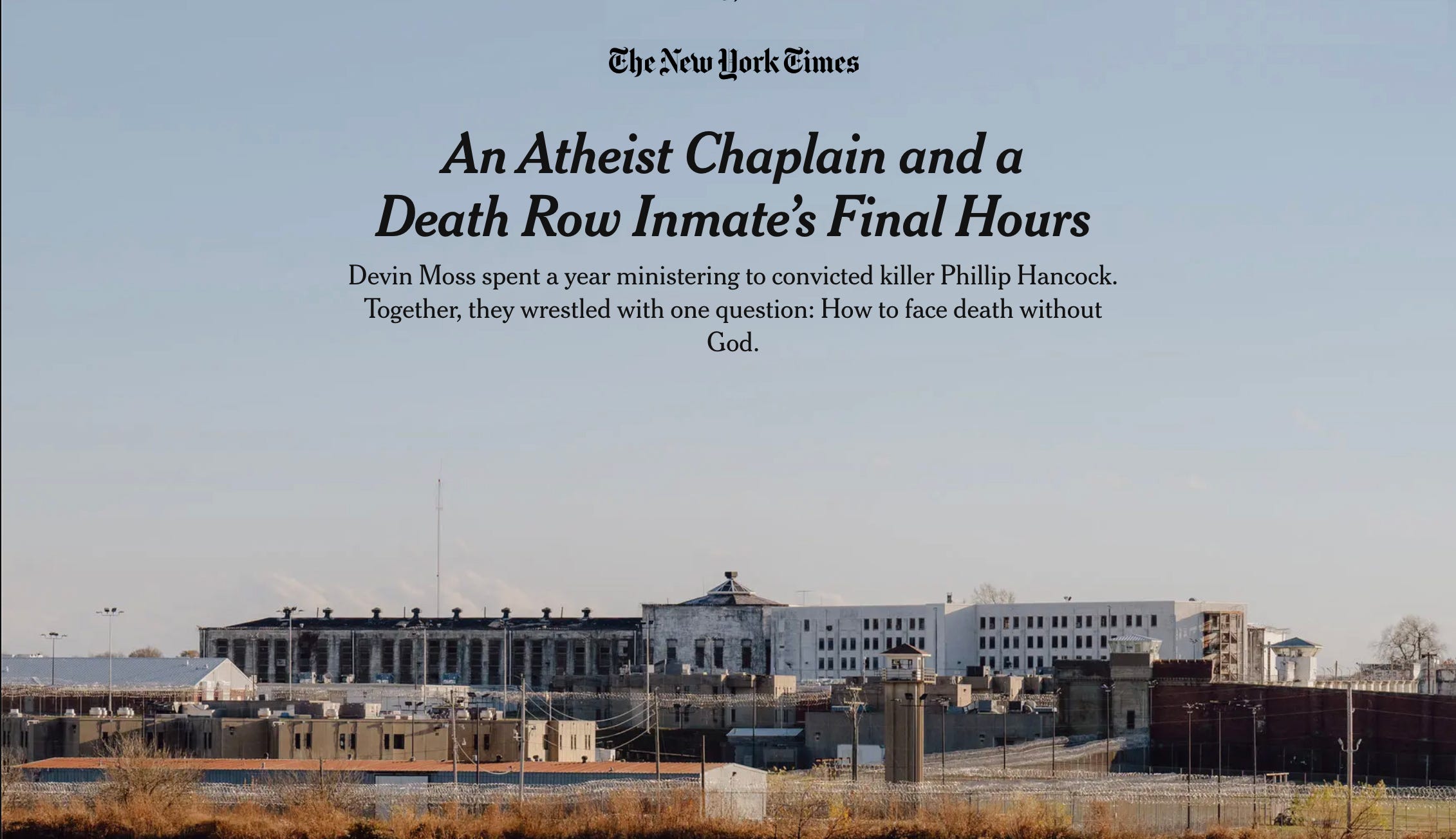
As his eyes closed and his chest rose and fell, liquid moving through the I.V., Moss stood at his feet, hoping his friend could hear him. “You are loved,” Moss said over and over. “You are not alone.”
Over these past two years
I’ve thought a lot about Phil, his family, our society, the lives of the two men he killed, justice, humanity, and I’ve thought a lot about fried chicken. Out of all the things to reflect on, Phil not getting his requested last meal triggers me the most. It’s the thing that makes me the angriest and the thing that makes me cry the quickest.
But why?
A commenter in one of the articles written about the execution posed that question more specifically: Why should we care if Phillip Hancock didn’t get the last meal he’d requested? He was convicted of two counts of first-degree murder and sentenced to death in accordance with the law.
It’s a fair question. One that many people would ask. So, why should we care?
Against the backdrop of so much tragedy, that question may seem inconsequential—but the answer reveals a cultural flaw so glaring in its pervasiveness that we’ve mistaken it for normal.
When she actually said the word—Nazi—I felt a strange relief. Finally, permission to admit the truth: I didn’t have the capacity to care about this person.
Here’s the answer - Caring has nothing to do with it.
The real question isn’t about caring—it’s about how to practice compassion. Fundamentally, we’ve confused the two. Compassion is a discipline, it’s a strength, not an emotion. And culturally, we’re weak ass tea.
Let me explain:
My journey to understanding compassion began on my chaplain internship at Bellevue Hospital during the COVID-19 pandemic. Bellevue, if you’re not familiar, has the historical distinction of being America’s oldest continuously operating public hospital. It serves as a safety net for New York City’s most vulnerable: people who are unhoused, uninsured, mentally ill, those whom society often overlooks. I assumed that because of the pandemic my greatest challenge would be figuring out how to sit with so much dying. But in truth, it was the suffering of the living that was hardest to be with—the despondency, the helplessness, the forsakenness.
I was tired most shifts, but on this particular day, I remember being especially exhausted. So I was caught flat-footed when I walked into a new patient’s room where an elderly white woman was throwing racial slurs at the black nurses.
My entrance was distraction enough for the nurses to before another insult could be hurled. And seeing that I was white and she was white, the 85-year-old woman thought she’d found an ally in her hatred. Within minutes, she proudly confessed to me that she was a Berlin-born Nazi.
When she actually said the word—Nazi—I felt a strange relief. Finally, permission to admit the truth: I didn’t have the capacity to care about this person.
That moment of truth cracked me down the middle. If I felt relieved to stop caring here, in this room, with this patient—what did that mean about all the other rooms? How many times that day, that week, that month had I been pretending? Performing sympathy I didn’t actually feel?
Caring, it turned out, wasn’t some endless well I could draw from. Exhaustion depleted it. Repetition numbed it. Repulsion blocked it entirely. I’d been treating caring like a professional skill I could summon on demand, and the Nazi patient was simply the first person who gave me permission to admit I’d been faking it.
Here’s what I’d gotten wrong: I thought being compassionate meant being all-forgiving, accepting of everybody in every room. Non-judgmental no matter what. And even worse—I thought it meant always having to be nice.
I’d always understood compassion the way the dictionary defines it: a feeling that arises when you witness someone suffering, coupled with the desire to help. The equation seemed simple:
recognize suffering + feel sympathy + take action = compassion
But Mr. Webster has it wrong. If compassion requires a sympathetic emotion, it will always fail us when we need it most - when others need it most. When we’re exhausted. When they’re a Nazi. When we simply could not care less.
So if not an emotion—what is compassion?
Compassion is a spiritual discipline
Spirit—as I’ve come to understand it, is the animating life force that connects you to others, the earth, and something bigger than yourself. Your spirit has nothing to do with when you die and everything to do with how you live.
Spirit is your tuning fork to life.
And like your body and mind, spirit requires intentional cultivation. Neglect it, and the whole system suffers. You become misaligned, imbalanced, out of sync, living disconnected from the earth, from each other, from deeper meaning.
Compassion lives in your spiritual dimension. In your capacity to connect with another human, to connect to something bigger than yourself, beyond your ego, beyond a mercurial emotional state. It’s not about feeling the right things. It’s about practicing presence with another person’s humanity, even when—especially when—everything in you wants to walk away.
And here’s why we’re so shit at it.
As Americans, we’re taught to love hard things. We worship grit. We celebrate the grind. From an early age we learn to mythologize the person who wakes up at 4 a.m. to hit the gym before crushing a twelve-hour workday. We turn “no pain, no gain” into spiritual wisdom. We build entire identities around never giving up, pushing through, doing one more rep when everyone else quits.
We excel at the grind.
And it’s not just physical. We’ve embraced mental and emotional strength too. We clock hours in therapy. We do the work to overcome our histories of trauma. We befriend our nuanced (and not so nuanced) emotions. We read all the self-help books, listen to the podcasts, do all the plant medicines, and Costa Rica our way into a happier version of ourselves. We’re committed to healing ourselves, understanding ourselves, improving ourselves.
We’re excellent at self-work.
But when it comes to compassion? When it requires us to show up for someone else’s suffering, someone else’s pain, someone we’ve decided doesn’t deserve our attention? We take the easy way out. We quit. Or worse, we don’t even try.
We pride ourselves on being strong, but hit us with the one thing that actually requires the most strength—practicing compassion for people who make us uncomfortable, people we’ve decided don’t deserve it, people whose suffering doesn’t benefit us—and we crumble like a day-old biscuit.
Compassion is America’s glass jaw.
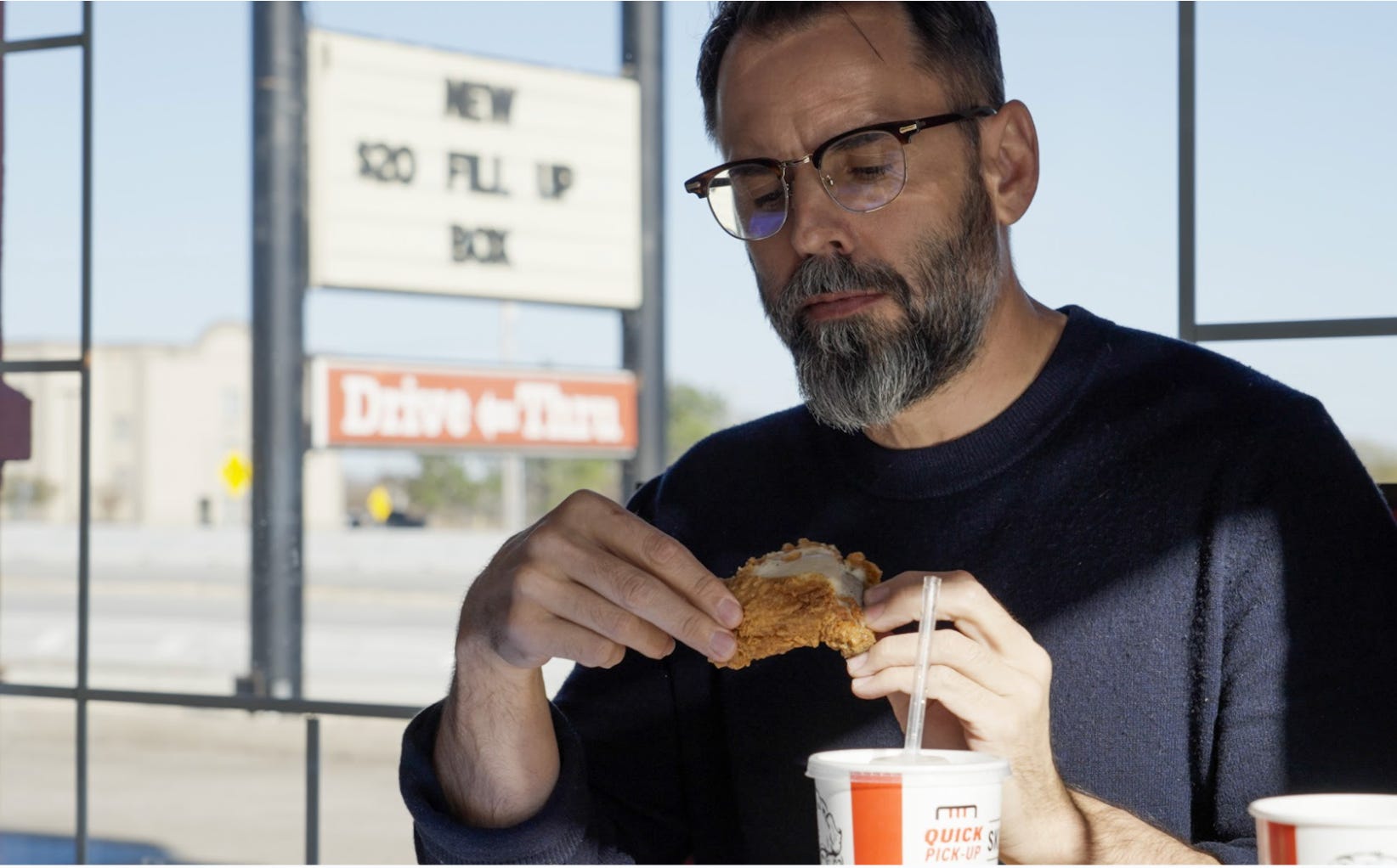
So why do I get so bothered by Phil’s chicken?
Because it’s the simplest possible test of compassion—and we failed it.
Think about what it would have required. One person in that chain of decisions—the warden, assistant warden, the corrections officer who placed the order, whoever picked it up—just one person needed to pause and think: This is a human being’s last meal on earth. Let me get it right.
That’s it. Not because they felt sympathy for Phil. Not because a convicted murderer earned their emotional caring. But because they had the spiritual discipline to practice compassion as presence—to recognize another person’s dignity no matter what they felt.
And if we can’t pass that test—the smallest, simplest one—we’ve already shown we don’t have the strength for anything harder. The world requires so much more.
I used to think that perhaps compassion is just for chaplains. For the care givers. The big hearted do-gooders of the world.
But that’s bullshit - because if we want to be balanced, connected, whole beings - if we sincerely want to live in a world that’s better tomorrow than it was today - then compassion must be a strength of each and every one of us.
Here’s the compassion framework that I use and teach:
First, have something to believe in. Beliefs require a leap of faith. They ask for our conviction and require our devotion. They forge a connection with something bigger than ourselves and become the scaffolding for life that informs us what to value and how to act. They do not, however, need to be metaphysical, mystical, or supernatural in any way. Me? I believe in humanity and the radical interconnectedness of all phenomena. I believe that we are all connected. Thou Art That.
The reason why belief is so important for compassion is because it becomes your touchstone - your centering - it’s your grounding outside your ego and emotion.
The second step of compassion is to face the suffering. Not fix it. Not understand it. Just be willing to be present with it. Compassion doesn’t require you to solve someone’s problems or even comprehend their pain. It only requires staying present with the one person in front of you. WARNING: Don’t try to face the suffering of the world (or a group). You’ll burn out too quickly. Just face the suffering of the person in front of you. One by one. One bucket of chicken at a time. That’s the work.
The third component is to recognize the stories involved. Yours and the sufferer’s. What narratives are playing out? What judgments are you making? What assumptions are they operating from? Simply recognize them. You don’t need to resolve them or untangle them or decide who’s right. Just see them as clear as you can.
And finally, if you’ve made it this far—be present with grace in your heart. Connect with a person who is suffering with an open heart, not a bleeding heart. Know the difference.
That’s compassion. That’s the discipline. That’s the skill. That’s the ultimate strength.
Believe in Something. Face the suffering person by person. Recognize the stories involved. Be present with grace in your heart.
You will be tested. Most likely today. And I wish you strength.
Phil’s Fried Chicken revealed our cultural weakness -our weak tea. And a weakness only becomes a strength through practice.
If you’re ready to cultivate your spiritual capacity, visit dsmoss.com
.
This was an incredible read! Thank you.
Thank you for this. ❤️